Do you need vitamin D in winter in the UK?
For most people, yes. From October to early March, food alone rarely makes up for the weak sun. Some people are advised to take 10 micrograms all year round, including anyone who is rarely outdoors, lives in a care home or usually covers most of their skin outside. The NHS also suggests that people with dark skin consider it all year.
Should you take vitamin D3 and K2 together?
You can, but not everyone needs both. Their jobs overlap. Vitamin D contributes to the normal absorption of calcium. Vitamin K contributes to the maintenance of normal bones.
They’re also hard to get in different ways. In winter, the UK sun can’t give you enough D3. K2 is mostly found in natto and some hard cheeses, which few of us eat. Our spray covers both, so there’s one less thing to remember.
Who shouldn't take vitamin D3 and K2?
Skip the spray if:
- You already take a multivitamin with D and K
- You take blood-thinning medication (speak to your GP first)
- You only want the NHS winter amount: a plain 10 microgram D3 does that job
Vitamin D2 vs D3: what's the difference?
Both are vitamin D. The difference is where they come from.
- D2 (ergocalciferol) is made by plants and fungi, such as mushrooms grown under UV light.
- D3 (cholecalciferol) is the form your own skin makes in sunlight. It's also the form found in oily fish, egg yolks and liver.
Most D3 is made from lanolin, the natural grease in sheep’s wool, so it isn’t vegan. Ours comes from lichen, a slow-growing organism found on rocks and trees, so it’s fully vegan.
Vitamin K1 vs K2 (and MK-4 vs MK-7): what's the difference?
If you're buying this as a “let's try this and see”, set expectations honestly from the start. It's better to give them a realistic timeline than have them expect results in the first week and quietly give up when nothing's changed after ten days.
In our customer survey, roughly 3 in 4 people hadn't noticed anything in their first two weeks. That's normal, not a sign it isn't the right fit. It's also why we back every order with a 60-day money-back guarantee, so trying it isn't a financial gamble while you both find out.Think of vitamin K as a family name. K1 is the one on your plate most days. K2 is the rarer relative, and it comes in several forms, each labelled MK and a number.
| Form | Chemical name | Where you find it | Worth knowing |
|---|---|---|---|
| K1 | Phylloquinone | Leafy greens such as spinach, kale and broccoli; vegetable oils | The main form in most diets |
| K2 (MK-4) | Menaquinone-4 | Meat, egg yolks, butter | Your body also makes some from K1 |
| K2 (MK-7) | Menaquinone-7 | Natto (fermented soybeans); smaller amounts in some cheeses | Made by fermentation. Stays in the blood longer than K1. |
Vitamin K helps your blood clot normally and plays a part in bone health. In plain terms, vitamin K switches on osteocalcin, a protein that binds calcium into bone.
The K2 in our spray is MK-7, the same form found in natto.
Which foods contain vitamin D3 and K2?
Most people get enough vitamin K from food. Vitamin D is harder: between October and early March, food alone rarely gives you enough, and K2 is mostly found in natto, which few of us eat.
| Nutrient | Main food sources | Worth knowing |
|---|---|---|
| Vitamin D3 | Oily fish (salmon, sardines, herring, mackerel), red meat, liver, egg yolks, fortified breakfast cereals and fat spreads | "Fortified" means vitamin D is added during manufacture. Check the label |
| Vitamin K2 | Natto, some hard cheeses, egg yolks, meat | Natto is the richest source, and a rarity on British plates |
So if you eat well and still wonder why either matters, that's the answer. Winter takes D3 out of your hands. K2 comes down to how often natto or some hard cheeses make it onto your plate.
How much vitamin D3 and K2 should you take a day?
Most adults need 10 micrograms (400 IU) of vitamin D a day in autumn and winter, and shouldn't take more than 100 micrograms (4,000 IU). For vitamin K, aim for about 1 microgram per kg of body weight.
How much vitamin D3 and K2 should you take a day?
Most adults need 10 micrograms (400 IU) of vitamin D a day in autumn and winter, and shouldn't take more than 100 micrograms (4,000 IU). For vitamin K, aim for about 1 microgram per kg of body weight.
| Nutrient | Daily amount (NHS) | Upper guide (NHS) |
|---|---|---|
| Vitamin D, adults | 10 micrograms (400 IU) | No more than 100 micrograms (4,000 IU) a day |
| Vitamin K, adults | About 1 microgram per kg of body weight (75 micrograms if you weigh 75kg) | 1mg (1,000 micrograms) or less a day from supplements is unlikely to cause harm |
| KURK D3+K2 Spray, per daily serving (7 sprays) | D3: 75 micrograms (3,000 IU). K2: 150 micrograms | Within the NHS adult limits for both vitamin D and vitamin K |
More isn't better. Taking too much vitamin D over a long period can cause calcium to build up in the body, and it's easy to overshoot by accident: a multivitamin, a fortified drink and a separate vitamin D product soon add up. Check the micrograms on every label.
When and how should you take vitamin D3 and K2?
Once a day, at a time you'll remember. The routine that lasts is the one attached to something you already do. If KURK Liquid Curcumin is already in your routine, that’s your moment.
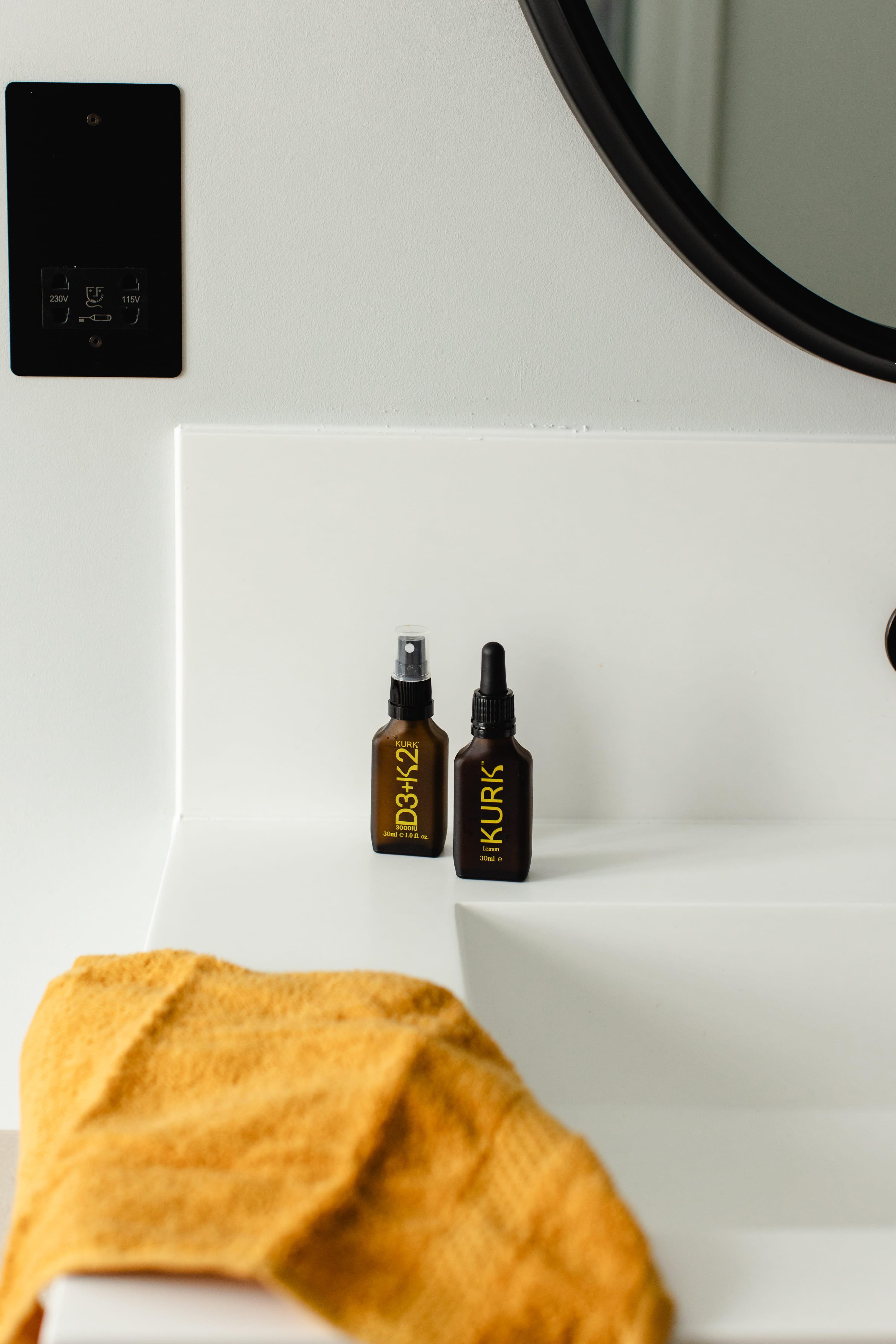
Keep the bottles together. Put the spray next to your KURK. What you see each morning, you use.
Pair it with breakfast. It’s a moment that happens every day, so the spray happens with it.
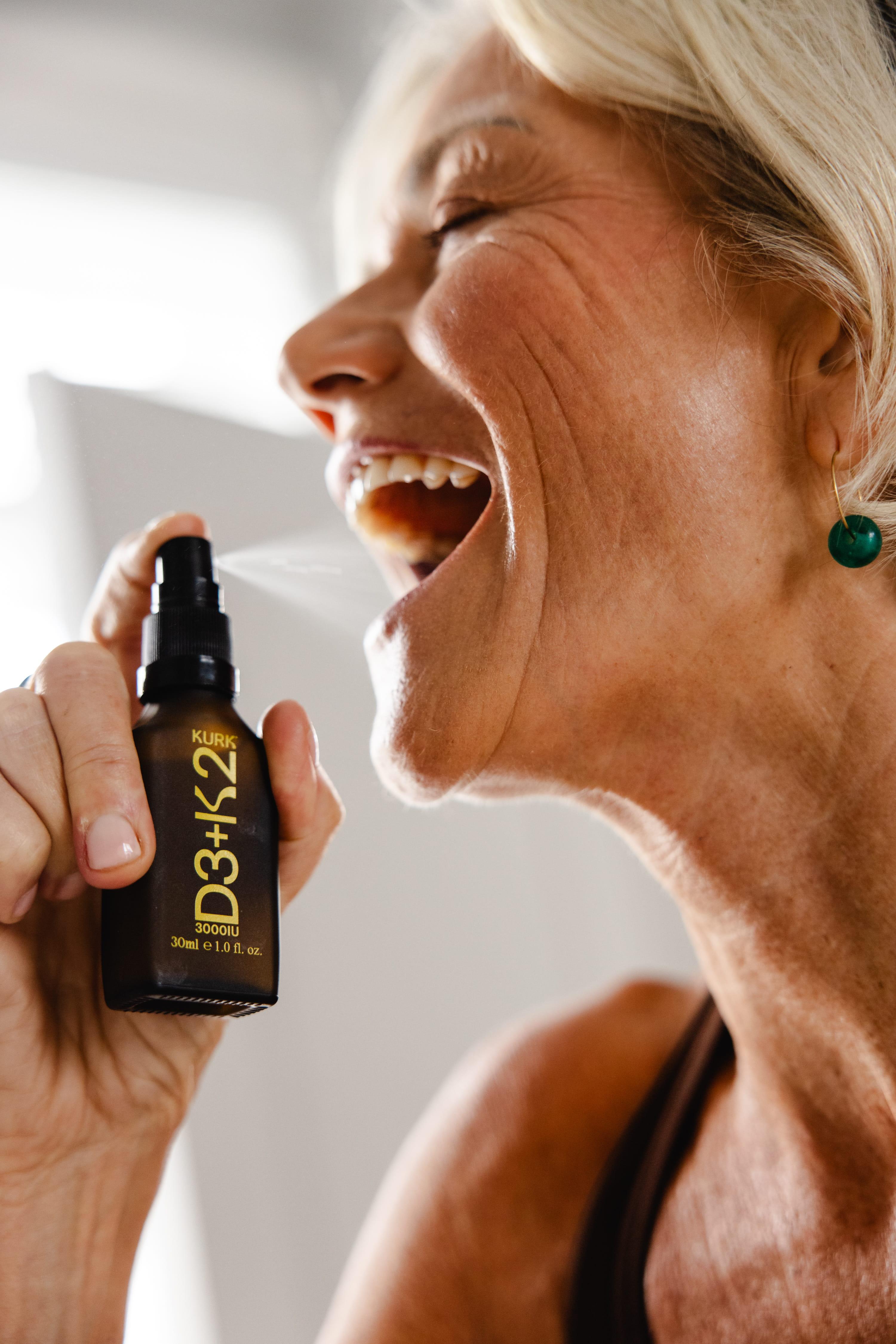
Follow the label. Shake well, spray 7 times under your tongue, hold for about 60 seconds, then swallow.
Let them arrive together. Add the spray to your basket with your next KURK order, so both arrive at once.
What's in the KURK D3+K2 Spray, and how is it made?
| KURK D3+K2 Spray | |
|---|---|
| Vitamin D3 per daily serving | 75 micrograms (3,000 IU), 1,500% NRV |
| Vitamin K2 per daily serving | 150 micrograms, as MK-7, 200% NRV |
| Vegan | Yes. Also soy-free and gluten-free |
| Other ingredients | Filtered water, vitamin K2 (all-trans MK-7), proprietary spice blend, vitamin D3 from lichen (cholecalciferol), peppermint essential oil, sweetener (steviol glycosides), rosemary extract, tea extract, vitamin E (alpha-tocopherol) |
| Servings per bottle | 30ml bottle, approx. 30 daily servings of 7 sprays (1ml) |
| Cost per day | About £1.67 a day as a one-off purchase (£49.99 a bottle). Subscribers pay less, and you can pause or cancel any time. |
| Bottle | Glass |
| Made at | KURK Biosciences, our ISO-certified lab in London |
From KURK Biosciences, the same London team behind KURK Liquid Curcumin. The full ingredient list is above and on the label.
FAQs
What are vitamin D3 and K2 good for?
Vitamin D contributes to the normal absorption of calcium and the maintenance of normal bones and muscle function. Vitamin K contributes to normal blood clotting and the maintenance of normal bones.
Is 3,000 IU (75 micrograms) of vitamin D3 a day safe?
It's within the NHS adult upper guide of 100 micrograms (4,000 IU) a day, but well above the 10 micrograms the NHS advises for autumn and winter. Count every source, including multivitamins and fortified foods, and if you're unsure, ask your GP or pharmacist.
Can I take it with KURK curcumin?
Yes. They're separate products that fit the same moment: KURK in your morning drink, the spray with breakfast. If you take any medication, check with your GP or pharmacist first.
Is vitamin D3 vegan?
Most isn't, because it's made from lanolin in sheep's wool. Ours is: the D3 comes from lichen, and the spray is also soy-free and gluten-free.
Can you take vitamin K2 with blood thinners?
Speak to your GP first. Vitamin K plays a role in blood clotting, so your GP needs to know before you start anything that contains it.
Always read the label and follow the directions for use. Food supplements should not be used as a substitute for a varied, balanced diet and a healthy lifestyle. Always speak to your doctor or pharmacist before starting any new supplement, especially if you are pregnant, breastfeeding, taking medication or managing a medical condition.
Sources
-
NHS. Vitamin D. Daily amounts, autumn and winter advice, upper limits.
-
NHS. Vitamin K. Daily amount, 1mg guide, diet.
-
Department of Health and Social Care. Great Britain nutrition and health claims (NHC) register.
-
Scientific Advisory Committee on Nutrition. Vitamin D and Health, July 2016.
-
Schurgers LJ, Vermeer C. Haemostasis, 2000;30(6):298–307. doi.org/10.1159/000054147. K1 and K2 in food.
-
Schurgers LJ, Teunissen KJ, Hamulyák K, et al. Blood, 2007;109(8):3279–83. doi.org/10.1182/blood-2006-08-040709. MK-7 vs K1 in the blood.
Related reading:
Turmeric vs curcumin: what's the difference and why it matters
Does KURK work? The evidence behind 185×