

Turmeric and curcumin aren't the same thing. Turmeric is the whole root. Curcumin is the one active compound inside it that most research, and most of what you've read online, is actually about. And on its own, in food or in a standard capsule, your body absorbs very little of it.
Turmeric has been part of Ayurvedic practice and South Asian cooking for thousands of years, and more recently it's turned up in golden lattes, functional drinks and skincare. But "turmeric" and "curcumin" get used interchangeably, and that mix-up is a big part of why so many people never notice a difference from taking it.
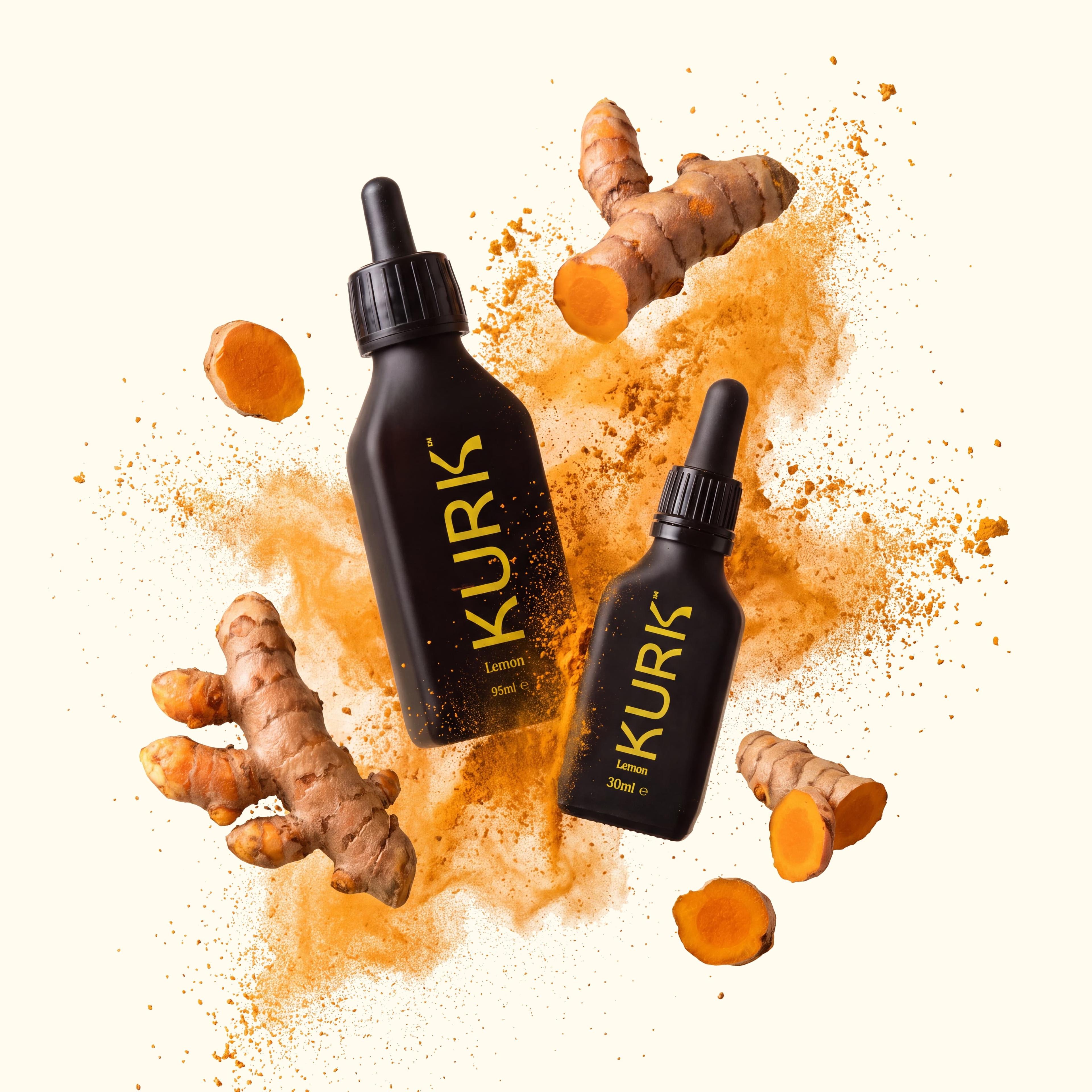
If you are comparing formats, KURK Liquid Curcumin is our liquid micellar curcumin, available in Vanilla, Orange, Lemon and Cola.
What is turmeric?
Fresh turmeric (Curcuma longa) is a root, part of the same plant family as ginger. Turmeric powder is made by boiling, drying and grinding that root, a process used for thousands of years across South Asian and Middle Eastern cooking.
Here's the catch: turmeric naturally has very low bioavailability. That means the body struggles to absorb its key active compounds in standard culinary form, whether that's a curry or an off-the-shelf capsule. [1]
What is curcumin?
Curcumin is the compound inside turmeric that everyone's actually asking about. It belongs to a group of plant nutrients called curcuminoids, first isolated from turmeric around 200 years ago, and it's what gives turmeric its golden colour.
Curcumin is one of the most widely studied plant compounds in the world. But turmeric root contains only around 3% curcumin by weight, and in its natural form, that curcumin isn't easily absorbed by the body either. [2]
Why turmeric alone isn't enough
This is the part most turmeric content skips: even pure curcumin, taken on its own, is poorly absorbed. It doesn't dissolve well in water and moves through the gut too quickly to be taken up in meaningful amounts. [3] That's the gap between "turmeric is good for you" and "turmeric is doing something measurable in your body."
Closing that gap is a formulation problem, not a turmeric problem. That's where KURK comes in.
So, why choose KURK curcumin?
Curcumin is the star of the show. It just needed some help from science to actually work.
At KURK Biosciences in London, our team spent six years developing a process that extracts and distils curcumin, then disperses it into a micellar liquid, engineered in-house rather than white-labelled from a generic supplier. Roughly 30kg of turmeric becomes 1kg of concentrated, active liquid curcumin: 185× more absorbable than standard turmeric powders or capsules. [4] And the research has not stopped: a two-year Knowledge Transfer Partnership with Swansea University Medical School, backed by Innovate UK, now places a researcher inside our lab full-time. [5]
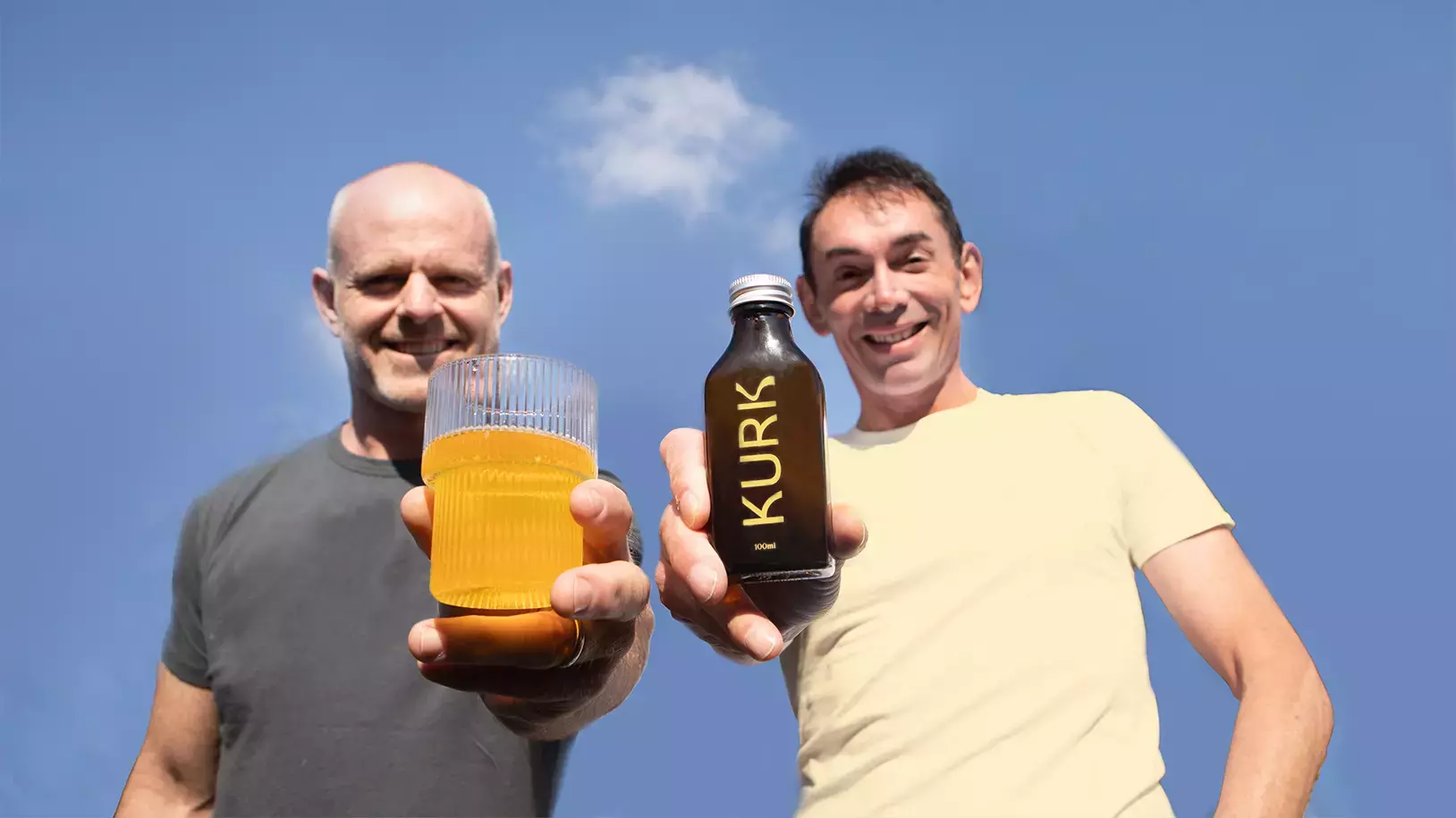
KURK was founded by two cancer survivors who set out to build the curcumin they wished existed when they needed it most, doctor-formulated from day one. That's the difference between a wellness trend and a curcumin biotech built on six years of in-house R&D.
Give it time. Most people take three months of consistent use before deciding whether it's for them, which is also why KURK backs it with a money-back guarantee.
In KURK, the best of nature meets the best of science: a modern, absorbable way to get the most out of one of the world's most studied plant compounds.
Plant science, perfected.
FAQs
Is turmeric the same as curcumin? No. Turmeric is the whole root. Curcumin is one active compound inside it, and the one most research (and most of the conversation online) is actually about.
Does turmeric contain curcumin? Yes, but only around 3% by weight, and in a form the body doesn't absorb well on its own.
Why does absorption matter more than the ingredient itself? Because an ingredient your body can't absorb can't do much, however good it looks on the label. Format (liquid, powder, capsule) and delivery technology, like micellar dispersion, matter as much as the ingredient itself.
Sources
[1] Hewlings & Kalman. Foods, 2017;6(10):92. https://doi.org/10.3390/foods6100092
[2] Tayyem et al. Nutrition and Cancer, 2006;55(2):126-131. Turmeric powder averaged 3.14% curcumin. https://pubmed.ncbi.nlm.nih.gov/17044766/
[3] Anand et al. Molecular Pharmaceutics, 2007;4(6):807-818. https://pubmed.ncbi.nlm.nih.gov/17999464/ — and Zheng & McClements. Molecules, 2020;25(12):2791. https://doi.org/10.3390/molecules25122791
[4] Schiborr et al. Molecular Nutrition and Food Research, 2014;58(3):516-527. Micellar curcumin 185-fold more bioavailable than native curcumin. https://doi.org/10.1002/mnfr.201300724
[5] Nutraceutical Business Review, 15 May 2026. https://nutraceuticalbusinessreview.com/kurk-swansea-medical-school-innovate-uk-curcumin-inflammatory